
Tim Schuster built a company around brainstorming. Then AI arrived and proved something he had suspected all along: the ideas were never really the point.
Tim Schuster has a way of making you feel like you just asked the right question.
That quality, the ability to receive a thought and return something more interesting than what arrived, is what he has organized his professional life around. He is the founder of Pop-UpThinkTank, based in Minneapolis, Minnesota, where he runs structured 90-minute ideation sessions for organizations ranging from corporate teams to nonprofits to startups, helping groups of twenty-five to sixty people think together in ways that leave them feeling energized rather than depleted. He lives in a blue house in North Minneapolis with his wife Kelsey and their two daughters, who are, as he cheerfully notes, dismantling the patriarchy one day at a time.
Before Pop-UpThinkTank, he had built and sold a company, spent time as an entrepreneur in residence at Thrivent, and co-founded a legal technology startup through Techstars. The thread connecting all of it, as he describes it, is an abiding belief that wherever there are people, there is meaningful work to be done. Pop-UpThinkTank is his most direct expression of that belief.
What Was Never About the Ideas
Pop-UpThinkTank was built around a founding insight rooted in careful observation: a pattern Schuster noticed across years of participating in corporate brainstorming sessions.
In the corporate brainstorming sessions Schuster was invited to participate in over years of innovation work, there was always a winning idea. Post-it notes would cover every wall. Design sprints would run for days. Ideation facilitators would build elaborate scaffolding to coax creative thinking from rooms full of people who had been told to think differently for one afternoon. And sometimes something genuinely good emerged. But what Schuster found himself tracking, in the days and weeks after those sessions, was not whether the idea survived. It was what the people in the room did with each other.
“What’s sticking isn’t so much the content of new ideas,” he says, “but more so the connections, relationship, ownership, emotional ownership that was built as a result of that.”
The best brainstorming sessions, he came to understand, were really doing something else. They were creating conditions for people to encounter each other in ways that the normal structure of organizational life did not allow. They were surfacing who cared about what, where there was latent energy, which people wanted to own which problems. The ideas themselves were often incidental. The human experience of generating them together was not.
Pop-UpThinkTank is the company he built around that realization: design the ideation process with the human experience as the primary outcome, and let whatever content emerges be a secondary benefit. He has been following that thread since 2016.
What AI Clarifies
The arrival of large-scale AI tools created what should have been an existential problem for a company built around getting people together to brainstorm. If a language model can generate thousands of ideas in seconds, each reasonably well-formed and many of them worth considering, why would you pay to gather forty people on a Zoom call to come up with the same ideas more slowly and at greater expense?
Schuster’s answer is that AI has done his argument a favor.
“What does ideation and brainstorming look like inside this AI moment?” he says. “For us, the answer is a chance to double down on the original thread. To remind ourselves, actually, this was never about the ideas.”
If the justification for bringing people together was always, at some level, the ideas they might produce, then AI has removed that justification. What remains is everything that was actually happening underneath it: people encountering each other, building shared language, discovering where their interests converge, forming the kinds of relationships that make organizations actually function. None of that can be generated by a model. It can only happen between people who are genuinely present with each other.
Schuster is paying close attention to what this shift is doing to the texture of organizational life. He notices how AI search tools have become the first stop for questions that employees used to bring to each other. The friction of not knowing something was also the friction that built relationships. Remove it entirely and you remove the occasions for connection. The career that never really connects with anyone, the organization whose people have all the answers at their fingertips but none of the trust that comes from having navigated uncertainty together: these are the patterns he is watching with genuine interest, not alarm, but with the kind of attentiveness that tends to precede a useful question.
The most instinctive uses of AI are also the most individualistic: save me time, help me produce, make me more efficient. What is not on that list is using AI to know your colleagues more fully, to work through an interpersonal challenge, to examine your own blind spots. The relational work, the harder and more human work, remains almost entirely outside how most people think to use the tools available to them. That gap is not a judgment. It is a map, pointing directly at where the most significant human work still lives.
Subject Becoming Object
Near the end of their conversation, Schuster arrives at an idea drawn from developmental psychology, one that illuminates something large about the moment we are in. The psychologist Robert Kegan spent decades studying how people grow, and he found that the most significant leaps in human development share a common structure: we cannot grow in relation to something we cannot see. As long as our assumptions remain invisible to us, we live inside them rather than with them. The moment they become visible, we can actually choose.
Think of it this way: if you have always believed that fish swim and breathe water without ever questioning whether water exists, you cannot make a decision about water. It is simply the medium you inhabit. But the moment you can see the water, you have a new kind of freedom. You can ask whether it is the right water, or whether there is something else you might want instead.
Schuster believes AI is making something newly visible at civilizational scale.
“Think of all human development and growth as subject becoming object,” he says. “My lens is now I can see it, and these language models are holding up a big giant mirror where we can see it. We can’t not grow.”
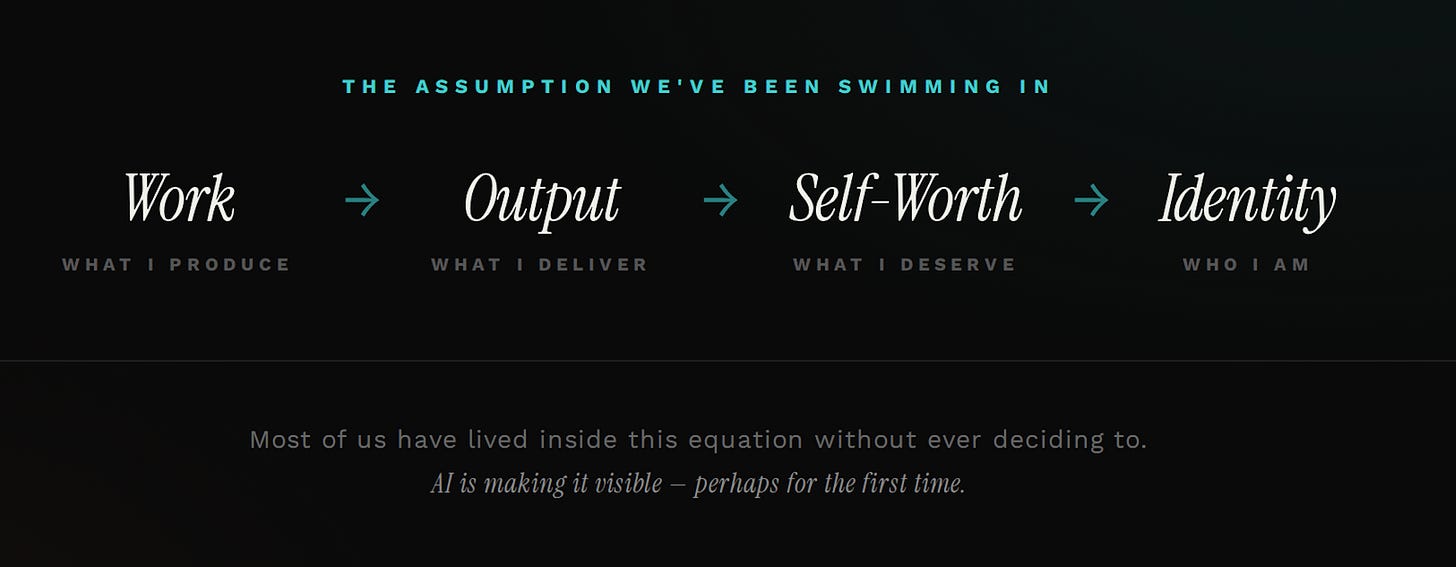
The assumption that work equals output, which equals self-worth, which equals identity: Schuster thinks this has been the water most of us have been swimming in for so long that we cannot see it as an assumption at all. It presents itself as simply how things are. But it is not a natural law. It is a historically specific framework, and AI is in the process of exposing it. When a machine can do much of what we previously defined as our productive value, the question of what human beings are actually worth becomes impossible to defer.
This, he thinks, might be the gift.
“Might all of this expose what’s been true all along,” he says, “that we’re at our best when work is conceived of as genuine, active love and service to fellow humans? Not about us. When it’s not about us.”
The analogy he reaches for is the discovery that the Earth was not flat. That was not a comfortable revelation for the people living through it. The frameworks that had organized life for centuries turned out to rest on a false premise. But the Earth had not been flat before Magellan’s voyage proved otherwise. The error had simply never been made visible. Something similar, Schuster suggests, may now be happening with the equation between production and human worth. The equation was always incomplete. It is only now being made object.
Kegan’s research documented that transitions between frameworks of meaning, while disorienting, consistently produce expanded capacity for relationship and complexity. The leaders who can hold the disorientation of this AI moment, who can acknowledge that the old assumptions are being made visible without knowing yet what replaces them, may be the ones most positioned to help their organizations grow through it.
Before the Words
Schuster makes one more observation worth pausing on. Language, he notes, is the past. Everything that has been named and categorized and trained into a model is, by definition, already known. AI is extraordinarily good at working with what is already known. But the frontier of human experience has always been pre-verbal: the thing we sense and feel before we have the words for it.
Art, he says, has always been the technology for capturing that pre-verbal knowing. The poem, the piece of music that moves you before you understand why: these are not decorations on the edge of serious work. They are how human beings have always approached the things that matter most before language catches up. In a world where AI can do virtually everything that has a word or a number attached to it, the pre-verbal becomes not a marginal concern but a central one. What cannot yet be captured in a prompt, what requires a human being to be present and alive in relationship with others: these are the things Pop-Up Think Tank is quietly building around.
What the Eulogy Would Say
Late in the conversation, Schuster was invited to imagine something. If someone were to look back on Pop-UpThinkTank years from now, whether the company had run for five more years or fifty, what would he want them to say? The question arrived with a loosely eulogy-shaped frame, and Schuster engaged it without hesitation, reaching not for metrics but for a feeling.
“People feel valued,” he says, “not when they’re told they’re valued, but when they have a chance to add value.”
Even in a ten-minute breakout, responding to a prompt alongside others who are responding to the same prompt, something happens that matters. People discover they had thoughts they did not know they had. They feel the particular energy of having contributed something real to a shared conversation. They are, briefly but genuinely, in contact with other people who are trying to figure something out alongside them. And that, Schuster has found over years of running these sessions, jars something loose.
In the age of AI, where the case for gathering people to generate ideas has never been more complicated, he finds this not more uncertain but more clear. The gathering was always in service of something AI cannot provide: the experience of being a person among persons, adding something real, being changed by the encounter. That was always the point.
One idea at a time.
Tim Schuster is the founder of Pop-UpThinkTank, based in Minneapolis, Minnesota. This conversation is part of the Humans & AI: Founder Series by HumanCulture.
PopUpThinkTank is also a proud member of HumanCulture. They have made a commitment to pursue a human-centered AI future.
Learn more about becoming a member.
Sources
Kegan, R. (1982). The evolving self: Problem and process in human development. Harvard University Press.
Kegan, R. (1994). In over our heads: The mental demands of modern life. Harvard University Press.
Pop-Up Think Tank. (2025). About us. https://popupthinktank.com/about-us
Related Stories


Let's Build a More Human Future of Work.
Whether you're exploring AI adoption, leadership alignment, or HumanCulture Membership, we'd love to learn more about your organization.